
Two batches of activated carbon can both carry "iodine number 1000 mg/g" on their certificates, and one of them can decolorize a sugar syrup in a single pass while the other barely changes its colour. Neither datasheet is lying. Every number on an activated carbon specification sheet is the result of an adsorption test performed with one probe molecule of one specific size, which means the sheet is not a score — it is a pore-size fingerprint. Buying on the single largest number on the page is the most common specification mistake we see, and it is entirely avoidable once you know what each line actually measures.
The iodine number, measured under ASTM D4607, uses iodine as a small probe molecule. Because iodine only fills the narrowest pores, the value tracks micropore volume — roughly the pore space below 2 nm — and correlates with specific surface area. Typical commercial grades fall between 700 and 1300 mg/g, and granular carbon for water treatment is commonly specified at 900–1100 mg/g. The iodine number predicts performance on small molecules: taste and odour compounds, low molecular weight solvents, and general "activity" of the carbon. What it does not predict is anything large. Colour bodies, humic acids and high molecular weight organics simply do not fit into micropores, so a high iodine number says nothing about how a carbon will behave in a decolorization duty.
For gas-phase work the relevant line is the carbon tetrachloride activity, or CTC number (ASTM D3467), often accompanied by butane working capacity (ASTM D5228). Unlike the iodine number, CTC is a dynamic vapour test: it measures how much CCl4 a carbon holds under flowing conditions, which makes it the datasheet line closest to real vapour recovery, solvent capture and respiratory cartridge duty. Typical values run from 40 to 80 percent, and solvent recovery systems are usually specified at the upper end. If you are buying carbon for a gas stream, CTC, moisture and hardness matter more than iodine value — a common inversion in purchase specifications.
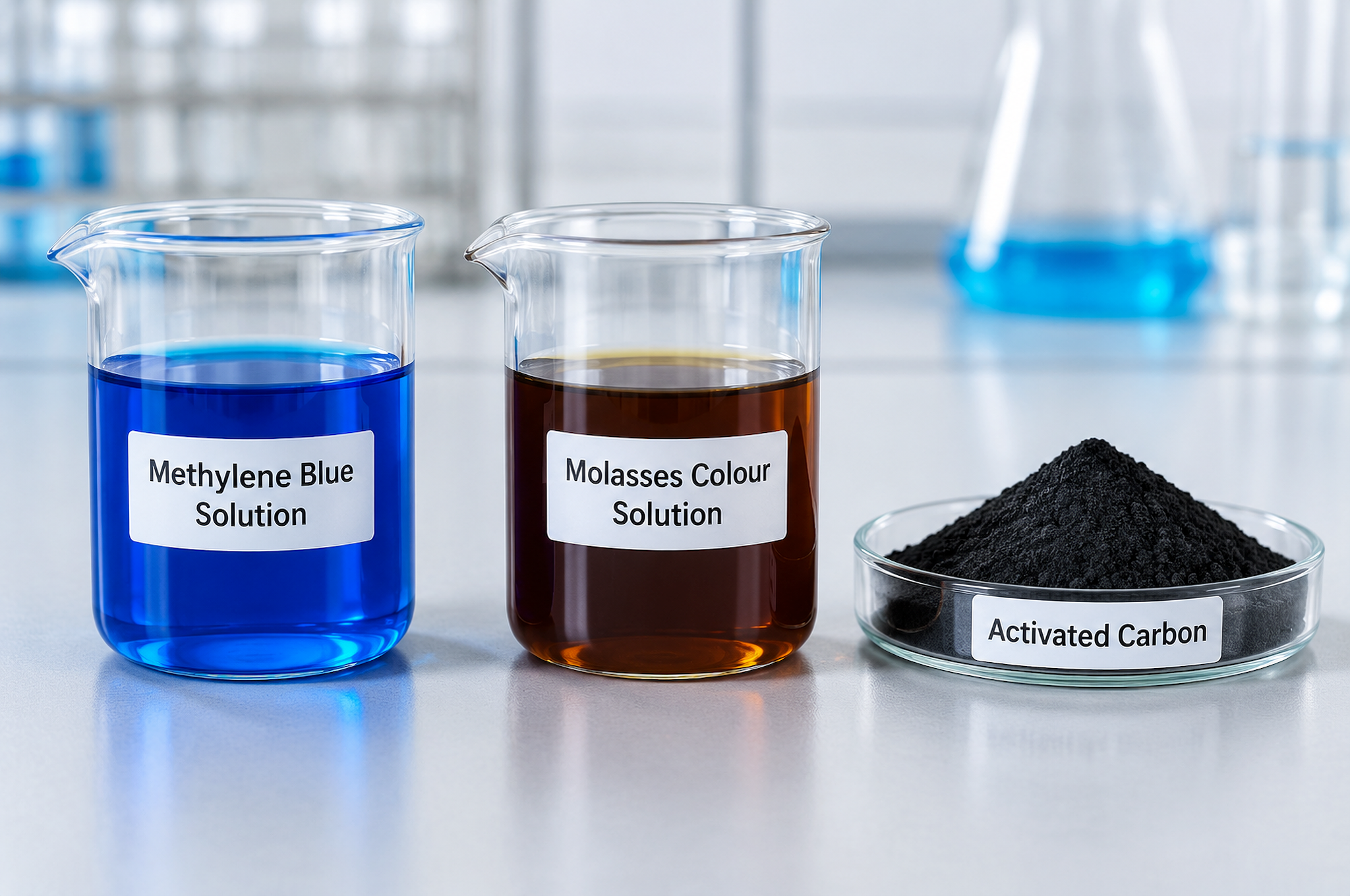
Methylene blue number and molasses number move up the pore scale into the mesopore range. Methylene blue is a mid-sized dye molecule, so its adsorption indicates capacity for medium molecular weight organics and coloured compounds; molasses number uses large caramel-type colour bodies and is the classic proxy for decolorization capacity. This is exactly where the two families of carbon diverge: a microporous coconut shell grade can show an excellent iodine number and only a modest molasses number, while a phosphoric-acid-activated shows the opposite profile — which is why food and beverage decolorization is a wood-based duty. One caution: molasses number has no single internationally standardized method, so values are comparable only within one supplier's own test procedure.
The physical lines on the sheet decide operating cost once the adsorption numbers are tied. Hardness — ball-pan hardness (ASTM D3802) or abrasion number (ASTM D4069) — governs attrition loss during backwashing and in , where carbon fines leave with the tailings and take loaded gold with them. (ASTM D2866) governs fines generation, pressure drop and the risk of leachable metals. Moisture is weight you pay for and cannot adsorb anything. Particle size distribution (ASTM D2862), quoted as effective size and uniformity coefficient, sets the trade-off between adsorption kinetics and head loss across the bed, and bulk density converts the kilograms you purchase into the bed volume you actually get.
A practical specification sequence follows from all of this. First define the target molecule's size and the phase it arrives in. Second, select the proxy test that matches it: iodine for small molecules and micropore activity, CTC for vapours, methylene blue and molasses for colour and mid-to-large organics. Third, set physical minimums for your contactor — hardness for backwash or pneumatic transfer, ash and size distribution for pressure drop, bulk density for bed sizing. Fourth, request the full panel plus a batch certificate of analysis, and note which standard family the numbers were measured under, because ASTM, EN and GB methods do not return identical values. For potable water duties, add NSF/ANSI 61 or the EN 12901 series compliance on top of the datasheet. A single headline number is marketing; the complete panel is engineering.
Kelin issues a full-panel certificate of analysis with every lot — iodine number, CTC or methylene blue and molasses values as applicable, hardness, ash, moisture and size distribution — and specifies grades by duty rather than by headline figure. Send us the contaminant, its concentration and your contactor type, and we will recommend the grade whose pore structure matches your molecule, with free samples for bench verification before you commit to a volume order.
Contact Us → | WhatsApp: +86 18236900853
 Get Free Sample
 WhatsApp