
A granular activated carbon filter can contain the correct grade of carbon and still fail early if the vessel gives the water too little time to contact it. This is why carbon selection and equipment design cannot be separated. Iodine number, pore structure and particle size describe the media, but empty bed contact time describes how that media is used. EBCT is the theoretical time that the untreated water would occupy the empty media bed at the design flow rate. It is calculated from the carbon-bed volume divided by the hydraulic flow rate:
EBCT = Carbon Bed Volume ÷ Flow Rate
If a vessel contains 10 cubic metres of carbon and receives 1 cubic metre per minute, its EBCT is 10 minutes. If the flow rises by 25% without adding bed volume, EBCT falls to 8 minutes. Nothing about the carbon itself has changed, yet the reduced contact time can move breakthrough forward substantially. The formula is simple; selecting the right value is not. There is no universal EBCT that applies to every contaminant, because adsorption rate depends on molecular size, concentration, water temperature, competing organic matter, carbon properties and the required treated-water limit.
EBCT should not be mistaken for the exact time that every water molecule remains inside the vessel. The spaces between the carbon grains, the internal pore volume, flow distribution and vessel internals all affect the real hydraulic path. Channeling can allow part of the water to cross the bed much faster than the calculated value, while stagnant regions leave part of the carbon underused. A vessel may therefore have an acceptable theoretical EBCT and still perform poorly because the inlet distributor, support gravel, backwashing or media loading created an uneven flow pattern. EBCT is a design indicator, not a substitute for sound hydraulics.
Bed depth matters because adsorption does not occur uniformly through the whole vessel. When a new bed enters service, the upstream carbon begins loading first. Between the saturated upstream zone and the unused downstream carbon lies the mass-transfer zone, where contaminant concentration falls from the influent level toward the treated-water level. As operation continues, this zone travels through the bed. Breakthrough begins when its leading edge reaches the outlet. A bed that is shallower than the effective mass-transfer zone can allow early breakthrough before much of its nominal adsorption capacity has been used.
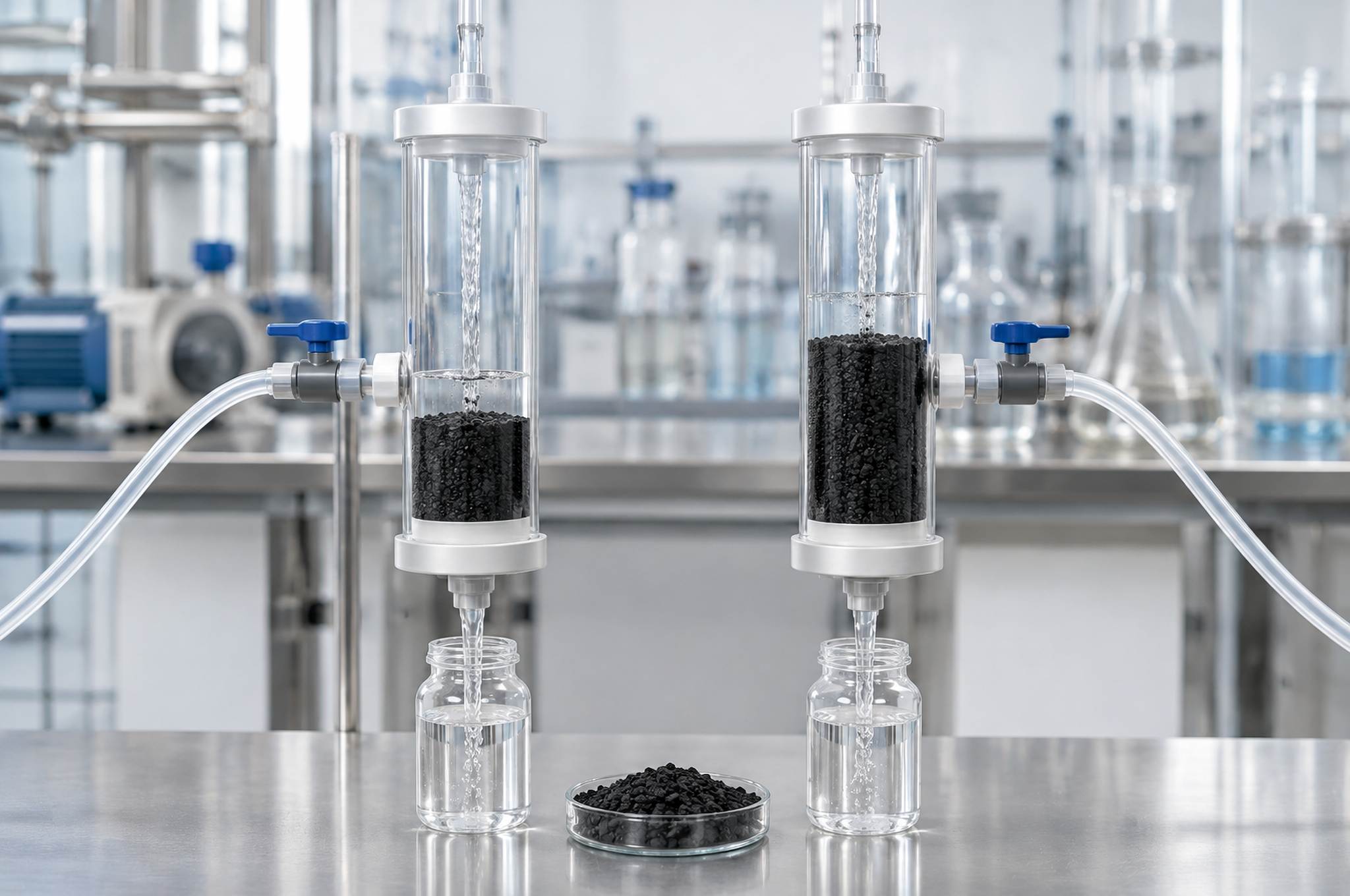
Increasing bed depth usually increases EBCT and gives the mass-transfer zone more distance to develop, but depth cannot be increased without considering pressure drop. Smaller carbon particles shorten the diffusion path and often improve adsorption kinetics, yet they also produce more hydraulic resistance. Larger particles lower pressure drop but may require more contact time because contaminants must travel farther into the granule. This is why particle size, effective size, uniformity coefficient, hardness and fines content belong in the same design discussion as adsorption capacity. Selecting a very fine carbon to improve kinetics can be counterproductive if pressure rises, flow becomes unstable or frequent backwashing causes media loss.
Flow variation is another common source of underperformance. A filter designed around average flow may experience substantially lower EBCT during daily peaks, seasonal production increases or the temporary shutdown of a parallel vessel. Those short high-flow periods can push the mass-transfer zone toward the outlet and produce contaminant spikes that disappear when flow returns to normal. Design should therefore consider the maximum credible hydraulic loading, not only the monthly average. Where flow varies widely, parallel vessels or flow-controlled operation provide more protection than a single vessel sized around ideal conditions.
Water chemistry determines how effectively the available contact time is used. Natural organic matter competes for adsorption sites and may occupy pore volume before the target contaminant reaches the carbon. Suspended solids and precipitated metals can block flow paths and increase differential pressure. Lower water temperatures may slow diffusion, while pH can change the charge and adsorption behaviour of some contaminants. Pretreatment is therefore part of GAC design. Removing solids and controlling upstream chemistry can extend bed life more economically than adding carbon to a vessel that continues to foul.
Lead-and-lag vessels improve capacity utilization and reduce breakthrough risk. The lead vessel receives the untreated water and uses most of its adsorption capacity, while the lag vessel polishes the lead-vessel effluent. Sampling between the two vessels shows when the first bed is approaching its operating limit; the final outlet confirms that the second bed remains protective. When the lead vessel reaches its replacement criterion, the lag vessel can move into the lead position and a fresh vessel or newly filled bed can be installed downstream. This arrangement allows more of the carbon’s usable capacity to be recovered without sacrificing final water quality.
Pilot testing remains the most reliable method for choosing EBCT when the water contains a complex mixture. Small columns can compare carbon grades, bed depths and flow rates using the actual source water. The resulting breakthrough curves show more than a single laboratory adsorption number: they reveal how rapidly the contaminant loads the bed, how sharply breakthrough occurs and how strongly competing substances affect capacity. A pilot test should preserve practical relationships between particle size, hydraulic loading and bed depth wherever possible; otherwise, a laboratory result may overestimate full-scale performance.
Operating data should continue the work after commissioning. Differential pressure, flow rate, treated-water concentration, backwash behaviour and carbon replacement dates should be logged together. A change in treated-water quality does not always mean that the carbon is saturated: channeling, fouling, fines accumulation or a change in influent chemistry can produce similar symptoms. Tracking these variables allows the operator to distinguish a media-capacity problem from a hydraulic problem and prevents usable carbon from being replaced unnecessarily.
Kelin supplies coal-based and coconut-shell granular activated carbon in controlled particle-size grades for fixed-bed water-treatment systems. Selecting the media should begin with the target contaminant, influent concentration, required outlet, maximum flow, vessel dimensions and expected EBCT—not iodine number alone. Provide these operating conditions when requesting a grade, and the carbon’s pore structure, particle size and mechanical strength can be matched to the contactor and treatment objective. Free samples are available for pilot and laboratory evaluation before full-scale loading.
Contact Us →
Email: info@zzzkelin.com
Phone / WhatsApp: +86 18236900853
 Get Free Sample
 WhatsApp