
Biological activated carbon is not a product grade; it is a state that granular carbon reaches. When GAC is used as filter media in drinking water treatment, microorganisms colonise its surface and pores, and after a period of operation the bed stops behaving like a pure adsorber and starts behaving partly like a biological reactor. This is put to work deliberately in the ozone-BAC process: ozone oxidises large, poorly adsorbable organic molecules into smaller biodegradable fragments, and the carbon bed that follows removes them biologically. The result is water with less biodegradable organic carbon, less potential for regrowth in the distribution network, and fewer disinfection by-product precursors. It earns its place where conventional treatment leaves too much biodegradable material behind, which is most often the case for surface waters drawn from rivers and reservoirs with elevated organic content.
A BAC bed passes through three recognisable phases. In the first, adsorption does the work and the carbon is simply a filter medium. In the second, adsorption and biodegradation operate together as the biofilm establishes itself. In the third, biodegradation dominates and the bed reaches a steady state that is far longer-lived than an adsorption-only bed: published long-term work has reported assimilable organic carbon remaining at or below 10 micrograms per litre after four years and 100,000 bed volumes of throughput. Temperature is the single largest influence on that performance. Biological activity slows sharply in cold water, and filters that perform well in summer are measurably weaker in winter, so a design based on warm-season data can disappoint.
Design therefore turns on two variables: contact time and the pre-treatment upstream. In published field work, parallel BAC filters have been operated for 16 months at empty bed contact times of 10 and 20 minutes over beds 0.8 metres deep. Comparative studies point in a consistent direction: adding pre-ozonation and choosing BAC media rather than anthracite improves removal more than simply raising the ozone dose or extending contact time. The practical conclusion is that a BAC stage needs adequate contact time, sufficient dissolved oxygen for the biofilm, and the right media, rather than maximum values of everything. The biofilm draws oxygen from the water passing through it, so a bed that turns anoxic starves the biology; maintaining an oxygen residual after ozonation is a design condition rather than an incidental detail.
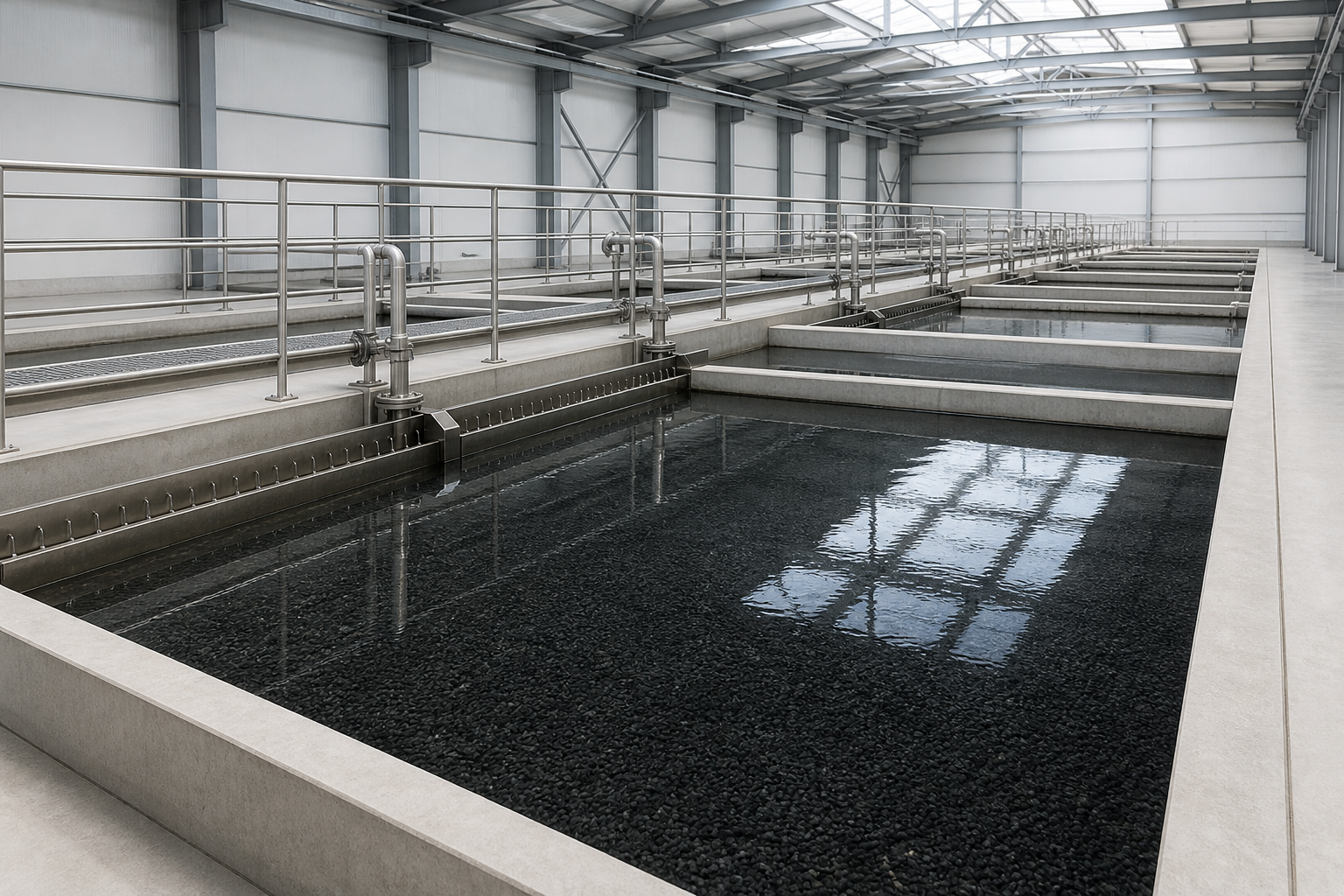
Media specification follows from that. Coal-based GAC with a high iodine value supplies the surface area, but a balanced pore structure matters as much: the bed has to hold a biofilm without its transport pores blinding, so mesoporosity cannot be sacrificed to a headline adsorption number. Particle size is usually 8×30 or 12×40 mesh, coarse enough that repeated air-and-water backwashing does not wash media out or grind the bed into fines, and fine enough to keep filtration performance. Hardness and uniformity determine how many backwash cycles the bed survives, and every kilogram of media lost to attrition is a kilogram of biofilm lost with it. Media is commonly replaced on a six to eight year cycle, although beds older than ten years are common where source water allows. Because the carbon cannot be judged by iodine value alone, the useful specification is the one supported by pilot data from the actual water at the actual temperature.

 Get Free Sample
 WhatsApp