
In the CO2 purification process, activated carbon primarily acts as a "smell and flavor police," removing trace organic matter and off-flavors.
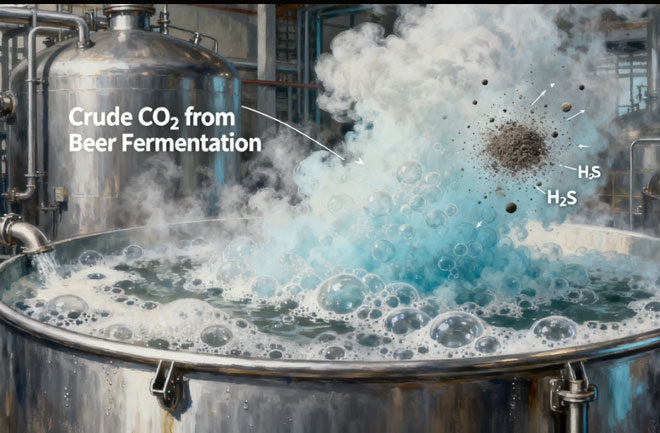

1. Sources of Impurities in CO2
In addition to the target gas, crude CO2 gas produced by beer fermentation or other industrial sources contains a variety of impurities:
Volatile organic compounds: such as ethanol, esters, aldehydes, sulfides (such as dimethyl sulfide), and higher alcohols (fusel oils). These are byproducts of beer fermentation and can cause unpleasant off-flavors.
Trace oils: from the compressor.
Water: saturated water vapor.
2. Activated Carbon Purification Principles and Functions
Activated carbon purifies CO2 primarily through physical adsorption and, to a limited extent, chemical adsorption.
Physical Adsorption:
Activated carbon has an extremely well-developed pore structure, particularly micropores, which provide a vast surface area for adsorption of impurity molecules.
CO2 molecules are inherently small, while molecules of various odor-causing organic compounds (such as alcohols, esters, and aldehydes) are larger. When the gas mixture passes through the activated carbon bed, these large molecules are firmly "trapped" in the pores, while pure CO2 molecules pass through smoothly.
Chemical Adsorption (Targeting Specific Impurities):
Some activated carbons undergo an "impregnation treatment," such as with potassium permanganate or iodine, specifically designed to oxidatively remove strong-odor impurities such as sulfur compounds (such as mercaptans and hydrogen sulfide).
Core Function: Activated carbon specifically adsorbs trace volatile organic compounds and odors that cannot be removed by traditional washing, dust removal, and drying methods, ensuring that the CO2 is odorless and does not affect the pure flavor of the beverage.
III. Typical CO2 Purification Process Flow
The activated carbon adsorption tower is part of the overall purification system, typically located at the back end or end of the process for "finishing processing." The complete process is as follows:
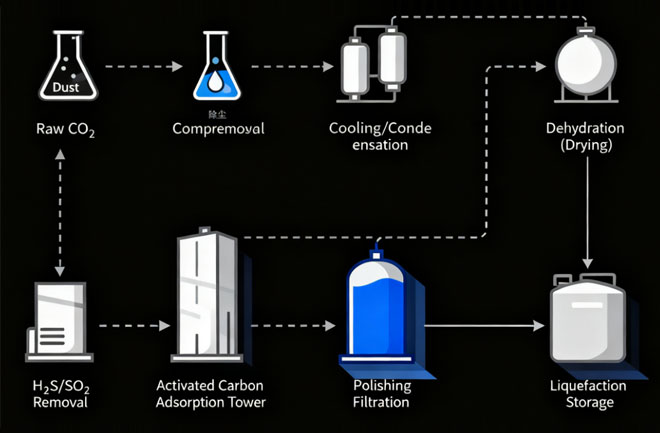
Crude CO₂ → Dust Removal → Compression → Cooling/Condensation → Dehydration (Drying) → H₂S/SO₂ Removal → Activated Carbon Adsorption Tower → Fine Filtration → Liquefaction and Storage
Process Detail:
Pre-treatment: Water, oil, and most sulfur compounds must be removed first. This is because water vapor competes with organic matter for adsorption sites on activated carbon, and oil clogs the pores, significantly reducing its adsorption efficiency and service life.
Activated Carbon Adsorption: Relatively clean CO₂ gas, having undergone pre-treatment, enters the bottom of the adsorption tower and passes through the activated carbon bed. During this process, any remaining trace odors and VOCs are effectively removed.
Post-Finishing: A fine filter is typically installed after the activated carbon tower to capture any extremely fine carbon dust that may have escaped the activated carbon bed.
Colin Activated Carbon strictly adheres to food standards and is your best choice.
 Get Free Sample
 WhatsApp